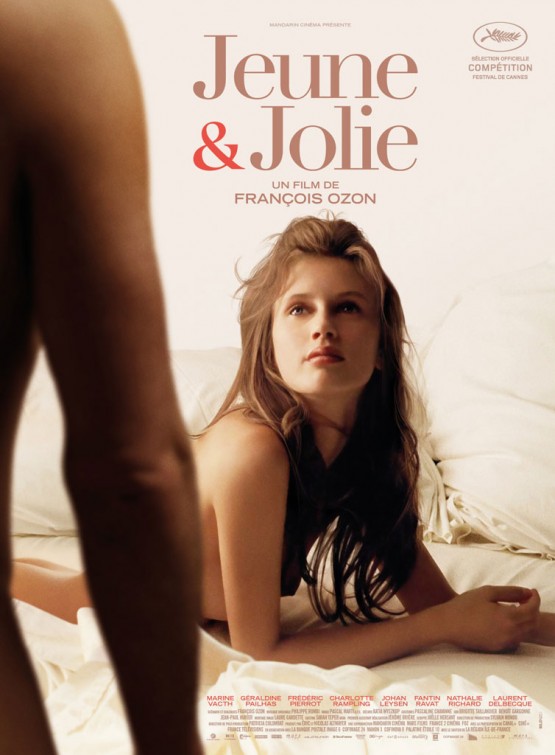
In an interview Francois Ozon said that he believed every women secretly fantasizes about being a prostitute. There is a hint of that in the final scenes of the film where George's wife actually admits to it. Overall though, this attitudes translates really well into the film. As I think, it's not necessarily good nor bad.
Prostitution is definitely romanticized here. It's not something the viewer feels dirty about: the film is more about fulfilling one's sexual fantasies. And in a way, this is a good representation of a very popular feminist (I suppose it's feminist because it seems so but I might be very incorrect and stereotyping) anti-slut-shaming thesis: women can enjoy sex, too. They can experience it with different men and they don't deserve to be called sluts for that, when men are definitely not being condemned for being "players" and "polygamous."
But this glamorized version of prostitution is not even remotely realistic. There is that bit with her second client but it's just a moment, a fleeting thing. It teaches her stuff about how to work. But it's not true; it's not as safe, it's not as nice, and the prices are not real (I guess they aren't, that's just too much but I'm not an expert).
As my friend said, if a young, sensitive, a little adventurous 17-years old girl saw the film, she would want to try this, too. And it's not exactly a path that might lead them to the ending of the film. It's not always a happy ending.
"Tu es ravissante," says George. The film is ravissant, gives some food for thought, so overall, an enjoyment.
Showing posts with label teenagers. Show all posts
Monday, September 2, 2013
Jeune&Jolie
Labels:
Francois Ozon,
Jeune&Jolie,
love,
prostitutes,
sex,
teenagers,
Young&Beautiful
Thursday, August 1, 2013
Inside Daisy Clover (1965)
It's more of a story about a teenager than of show business. Irrepressible power and desire to be free. This is why Daisy fell in love with Wade: he gave her freedom from the restraints of the world.
She doesn't care about trust, about lies. No one cares and everyone lies. Cheaters, money-seekers, fame-seekers, it's unpleasant but it's also distant. After all, Daisy doesn't let it get to her.
Wade is obviously supposed to be a bigger character because he says smart astute things, like "What is it that makes us rich, successful and unhappy?"; "Poor rich lonely lovely Mrs.Swan" (yeah, I wrote down these quotes, doesn't make me a hipster). The author is speaking through him but it's so quite and unimportant. It's just a small part, yet it does add to the atmosphere of the film as a whole. According to wikipedia, it's the first representation of a gay character in media who doesn't kill himself or is ashamed of his sexuality. Well, he obviously doesn't care and he keeps doing what he's doing because it's what he does best.
Also, I'm not sure there was such good editing in the 1930-s. Jumping around the stars? Hmm...
She doesn't care about trust, about lies. No one cares and everyone lies. Cheaters, money-seekers, fame-seekers, it's unpleasant but it's also distant. After all, Daisy doesn't let it get to her.
Wade is obviously supposed to be a bigger character because he says smart astute things, like "What is it that makes us rich, successful and unhappy?"; "Poor rich lonely lovely Mrs.Swan" (yeah, I wrote down these quotes, doesn't make me a hipster). The author is speaking through him but it's so quite and unimportant. It's just a small part, yet it does add to the atmosphere of the film as a whole. According to wikipedia, it's the first representation of a gay character in media who doesn't kill himself or is ashamed of his sexuality. Well, he obviously doesn't care and he keeps doing what he's doing because it's what he does best.
Also, I'm not sure there was such good editing in the 1930-s. Jumping around the stars? Hmm...
Labels:
cheating,
Christopher Plummer,
drama,
fame,
film 11,
gays,
Hollywood,
Inside Daisy Clover,
lies,
movies,
Natalie Wood,
singing,
teenagers
Friday, July 19, 2013
The Bling Ring
Lately I've found out that I should always start with my opinion of the film because apparently my "analysis" has a tendency to be negative, whatever it means.
If I don't agree with the message of the film (or think that it doesn't have one), it doesn't mean I didn't enjoy it. Duh.
I liked this one. I like Sofia Coppola's work: it's stylish, very musical and well done. I like Kirsten Dunst (even though she appears here very briefly) and I like pretty clothes (there is plenty of that in the movie).
The film is short (which is terrific!), the plot moves fast and it's visually appealing (all those nice things, what, I'm a girl!).
Stealing things, entering without permission and just going too far is bad. We know it.
Materialism is innate to American culture (it really is, you can't deny it)
But there's probably a reason why Coppola decided to make this movie. It might seem that it doesn't have something profound to say but what if it does?
It's not as simple as a story of teenagers who have too much time on their hands. It seems like more of a satire of the Hollywood socialites whose lifestyle really inspires these teens because nothing else apparently does. They are difficult kids but their parents don't seem to care. Their parents aren't role models, they are either overbearing or almost invisible. These kids are lost in the big bad world and they are only able to follow the examples of Paris Hilton, Lindsey Lohan and the like.
It's not a new issue but we still haven't found the solution to this.
If I don't agree with the message of the film (or think that it doesn't have one), it doesn't mean I didn't enjoy it. Duh.
I liked this one. I like Sofia Coppola's work: it's stylish, very musical and well done. I like Kirsten Dunst (even though she appears here very briefly) and I like pretty clothes (there is plenty of that in the movie).
The film is short (which is terrific!), the plot moves fast and it's visually appealing (all those nice things, what, I'm a girl!).
Stealing things, entering without permission and just going too far is bad. We know it.
Materialism is innate to American culture (it really is, you can't deny it)
But there's probably a reason why Coppola decided to make this movie. It might seem that it doesn't have something profound to say but what if it does?
It's not as simple as a story of teenagers who have too much time on their hands. It seems like more of a satire of the Hollywood socialites whose lifestyle really inspires these teens because nothing else apparently does. They are difficult kids but their parents don't seem to care. Their parents aren't role models, they are either overbearing or almost invisible. These kids are lost in the big bad world and they are only able to follow the examples of Paris Hilton, Lindsey Lohan and the like.
It's not a new issue but we still haven't found the solution to this.
Labels:
alcohol,
drug use,
Emma Watson,
film 4,
film challenge,
materialism,
nice things,
parties,
socialites,
Sofia Coppola,
teenagers,
The Bling Ring
Subscribe to:
Posts (Atom)